
This summer, I had the incredible opportunity to take a fashion history course at Brown University. With Rhode Island School of Design right down the hill, our class was also able to visit the RISD Fleet Collection which houses a wide range of historical prints, magazines, and other fascinating works. The pochoir prints of E.A. Seguy especially caught my attention.

Vibrant colors and intricate line work give E.A. Seguy’s insect prints their alluring quality. Bugs, which typically arouse disgust, are transformed into objects of beauty in E.A. Seguy’s artwork. How did Seguy create such stunning pieces out of not-so-stunning subjects? Through the fascinating technique of pochoir.
Pochoir is French for stencil, and it was popular in the late 19th century up until the 1930s. Pochoir involves découpeurs, who cut metal into precise stencils, and coloristes, who then bring those stencils to life through various methods of coloring. Unfortunately, the medium fell out of popularity due to its time-consuming and labor-intensive nature.
However, we can still admire the many pochoir masterpieces of the past.
The Gazette du Bon Ton

The Gazette du Bon Ton was an early 20th century fashion magazine which featured pochoirs of the latest fashions. Artists such as Georges Barbier and Georges Lepape contributed creative prints that not only presented the clothes as art, but also served as breathtaking artworks themselves. Bursting with color and imagination, it’s no wonder that the Gazette du Bon Ton was one of the most influential fashion magazines of its time.
Joan Miró
Pochoir in the fashion realm was very refined and elegant, but Joan Miró, a Spanish artist, adopted a completely different style with his work.
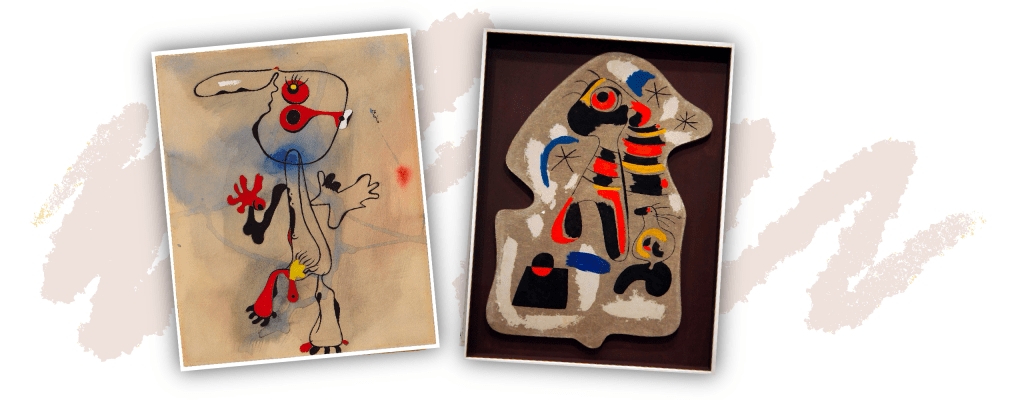
Miró’s pieces are abstract, relying primarily on 2D shapes and lines. His work is consistent with other surrealist pieces made during the early 20th century, when the style was gaining steam. The forms in Miró’s artwork include imaginary shapes as well as recognizable ones, reflecting a state of unconsciousness. Additionally, the dynamic hues and lines in Joan Miró’s work bring a fun rhythm to his art.
Today, mechanization has replaced the manual process of pochoir. While machines may produce more uniform stencils than découpeurs can, and while they may paint smoother finishes than can coloristes, it’s undeniable that machines cannot reproduce a certain charm- one that only humans can evoke. I’m grateful to have seen some of these beautiful works in person and to have been reminded of the wonders that can spring from unrestrained creativity, remarkable skill, and unmatched dedication.
References
Van Dyk, Stephen H., and Carolyn Siegel. Vibrant Visions, http://www.sil.si.edu/ondisplay/pochoir/intro.htm#:~:text=Pochoir%20is%20a%20refined%20stencil,center%20of%20activity%20in%20Paris. Accessed 8 Oct. 2023.
Russell. “Masters of the Pochoir.” Masters of the Pochoir | Stencil Archive, http://www.stencilarchive.org/content/masters-pochoir#:~:text=Two%20editions%20were%20enriched%20with,with%20two%20pochoirs%20of%20Pascin. Accessed 8 Oct. 2023.
“Research Guides: Pochoir: Art of the Stencil: Pochoir: History and Techniques.” Pochoir: History and Techniques – Pochoir: Art of the Stencil – Research Guides at Rhode Island School of Design, risd.libguides.com/pochoir. Accessed 8 Oct. 2023.
By. “E.A. Seguy, Insects, and the Art of Pochoir.” Walter Havighurst Special Collections The University Archives Preservation, 5 Apr. 2012, spec.lib.miamioh.edu/home/e-a-seguy-insects-and-the-art-of-pochoir/.
Erben, Walter. “Joan Miró.” Encyclopædia Britannica, Encyclopædia Britannica, inc., 26 Sept. 2023, http://www.britannica.com/biography/Joan-Miro.
 the aesthete